
Commentary on today’s Boston condo market
Boston Condos for Sale and Apartments for Rent
Commentary on today’s Boston condo market
September 14, 2026:
The Boston condo for sale market is experiencing longer market times today indicates that we’re getting back to normal. But what if this is the new normal?
Boston condos for sale buyers expect instant gratification these days, or they move on. The information overload makes buyers want to forget older listings, and of course days-on-market are published everywhere.
Rising prices used to eventually catch up with all the Boston condos under contract and bail them out. But what is pricing going flat for an extended time?
September 13, 2026:
“Current home prices are extremely important, but there’s much more that you need to look at when determining the health of a city’s real estate market. Factors like the cost of living, the potential for the value of homes to increase, the availability of recently-built homes and the quality of the city’s job market are all important to consider in conjunction with asking prices and interest rates. The best cities may not always be the cheapest, but they offer excellent housing options and long-term stability.”
July 31, 2026:
It’s been almost two years since the landmark lawsuit-settlement by NAR, and resulting change in how buyer-agents get paid. The intent was to have buyers be able to negotiate their commission rate with their buyer-agent.
How’s it working out?
Because everything is negotiable, buyers and their agents first agree to their commission rate, and then include a seller credit for the same amount in their offer to purchase. It’s flouting the rule but hey, you wanted to make everything negotiable, so here you go.
Then what happens?
1. In some cases, the seller’s listing agent wants to be a hero and save their client some money, so they decide to negotiate the buyer-agent commission downward. It causes the buyer-agent to become a party of the transaction, which is wrong on every level.
If the buyer doesn’t want to make up the difference, then the deal dies. There is an emotional trigger point where the buyer has already received the seller’s counteroffer and is grappling with paying a higher price for the home AND having to cough up more cash to make good on their buyer-broker agreement.
In a sensitive marketplace where emotions are teetering, it’s enough to topple a deal.
2. These buyer-broker agreements are for three months. We’ve seen how buyers sign up with an agent and then realize they are stuck with them for three months, for better or for worse.
3. Another result has been higher commissions to help pay for referral fees. A local team that has to pay Zillow a 40% finder’s fee is now charging their buyers 4%, and bumping their offers well above list price to compensate. Oh, that’s real buyer friendly.
About the only good thing that came out of this predicament is that the unscrupulous agents can’t steal a buyer away from a fellow agent – at least not until their contract expires. Glad for that result, but is that the only benefit?
Commentary on today’s Boston condo market
July 27, 2026: Why are interest rates still rising. Blame the Bond Market
- The Federal Reserve sets national interest rate policy.
- But some kinds of consumer debt, including mortgages and auto loans, are generally influenced by the yields on 10-year U.S. Treasury bonds.
- Treasury yields closed at their highest level since January 2025 on Thursday.
- Bond investors influence those yields via expectations around factors like inflation.
July 21, 2026:
Will the Boston condo for sale market withstand mortgage rates back in the upper 6s? That’s the question as we move forward into the summer of 2026, now that mortgage rates are at their highs for the year.
The Boston condo for sale market is still very picky, and not everything is selling…. yet. my listing in Charlestown a one one and half bedroom is still on the market and I’m not getting any calls from other brokers to schedule showings.
Nationally pending home sales came in at 79,000 contracts for the week, just under 1% below last year. The 4-week average is still slightly ahead of last year, but that gain could evaporate fast.
National Inventory
Inventory growth has flattened. My rule of thumb: when rates fall, inventory falls. With rates rising again, I expect inventory will rise.
Home Prices
Home prices are also basically flat compared to last year; However, Price reductions jumped to over 40% this week.
Pending Home Sales
Pending sales: 79,000 for the week, down 0.9% vs last year
July 16, 2026:
Here’s where things stand right now for the national marker:
Pending sales: 3.9% ahead of last year through July 10
Inventory: 1.07 million homes on the market, basically flat vs. last year
Days on market: 4% longer than a year ago, and falling
Home prices (Case-Shiller, through April): up 0.8% nationally year-over-year
Inventory growth is gone. All of that growth happened a year ago. Supply isn’t shrinking either, at least not while rates hold in the mid-to-upper sixes. If rates dip back toward 6%, I’d expect supply to start declining again.
On prices, the picture is uneven. Ten of the twenty major markets in the Case Shiller Index are now priced below last year, with Seattle the weakest. But Tampa and Miami are turning around, and Miami and San Francisco are now showing price growth, likely tied to the wealth effect from stock market gains. Chicago keeps leading price growth nationally, and that’s a supply story: there are 75% fewer homes on the market there than in 2019.
The spring buying season that just wrapped up was the best we’ve seen since 2022. But heading into the second half of the year, we’re watching inflation, energy prices, and whether the stock market wealth effect that’s been propping up demand in coastal cities holds up.
July 6, 2026: For years, America didn’t have enough homes to meet rising demand. Soon, it may not have enough homebuyers.
A new report from the Mortgage Bankers Association argues the housing market is nearing a major demographic shift. After more than a decade of demand outpacing supply, slower population growth and an aging population are expected to reduce the need for new housing, potentially reshaping forecasts for homebuilding, home prices and affordability.
That would mark a sharp reversal from the past decade.
June 17, 2026: Perhaps the biggest takeaway from first 6 months of 2026 is that the Boston condominium increasingly resembles a normal market rather than either extreme that defined recent years.
Boston condos for sale are taking longer to sell. Sellers are making more price reductions.
At the same time, demand has remained remarkably resilient.
The result is a market that looks increasingly balanced compared to the extremes of the past several years.
The anomaly was 2021 and 2022, not 2026.
Boston condos for Sale and the Bottom Line
For much of the past three years, the conversations on the Boston condo for sale market have focused on whether the market would break under the weight of higher rates.
June 9. 2026: We may think that Boston condo boomers are wealthy and will be showering cash all over the real estate market for decades to come. But that won’t impact the supply – especially if they just age-in-place for the next 20-30 years! We need them to move – and soon, before they get too old.
This article describes some of the complications – excerpts:
The housing market is where this financial anxiety becomes concrete.
Boomers and older Gen Xers own a disproportionate share of the nation’s three-bedroom-plus homes, including many in desirable urban and suburban neighborhoods. They bought those houses when prices were lower and interest rates were modest; many now hold mortgages with rates below 4% or own their homes outright.
The reason boomers don’t move isn’t just sentiment: Most boomer homeowners (about 54%) have no mortgage at all, so there’s little financial pressure to sell. A Redfin analysis of 2024 Census data found that empty-nest baby boomers (one- to two-adult households) own 28% of U.S. homes with three or more bedrooms, compared with 16% for millennial households with kids.
At one end is the anxious, under-saved retiree doing everything possible to stretch limited assets. At the other is the California homeowner who bought for just over $1 million and now sits on a home worth more than $4 million—but worries that selling would trigger close to $1 million in combined federal and state taxes. In the middle is a broad group that describes itself as “fine, but not secure” and treats staying in place—physically and professionally—as the only rational option.
Boomers largely followed the script they were given: Work hard, buy a house, save in tax-advantaged accounts, rely on Social Security to fill in the gaps. Many are now discovering in their late sixties and early seventies that the script did not account for a 90-year-plus life span or for the cumulative effects of wage stagnation, market crashes, and runaway medical costs.
Seen from the outside, they look like a wall of retirees hoarding houses and jobs; seen from the inside, they look like a generation quietly terrified of running out of money before they run out of years. To then be blamed for this structural issue, instead of recognizing its reality, seems a bridge too far.
https://finance.yahoo.com/economy/articles/golden-years-not-golden-boomers-113000201.html
What would it take for you to move?
Click- Menu of listing options for Boston condo sellers
Click to View Ford Realty’s Google Reviews

Ford Realty Beacon Hill – Condo for Sale Office

Boston condos for sale – Ford Realty Inc
Updated: Boston Condos for Sale Blog 2026
Byline – John Ford Boston Beacon Hill Condo Broker 137 Charles St. Boston, MA 02114
Boston Real Estate for Sale
May 31, 2026: The core focus of this market commentary is how geopolitical conflict dictates mortgage and interest rates more heavily than standard economic indicators. [1]
- Geopolitical Premium: Ongoing conflict acts as the primary driver for current market pricing.
- Strait of Hormuz: The critical shipping chokepoint heavily restricts global energy supplies while closed.
- Inflation Link: High energy costs directly pressure core inflation via supply chain disruptions.
- Fed Response: Sustained inflation forces the Federal Reserve to keep benchmark rates elevated.
- Mortgage Impact: High central bank rates directly translate to “higher-for-longer” consumer mortgage rates. [Bostonreb.com]
- Trigger: A diplomatic deal successfully reopens the Strait of Hormuz.
- Energy: Oil prices normalize quickly due to restored supply lines.
- Inflation: Upward pressure on consumer prices cools down rapidly.
- Rates: The Fed gains breathing room to potentially lower borrowing costs. [Ford Realty Inc]
- Trigger: The shipping bottleneck drags on indefinitely despite talks.
- Energy: Oil prices remain structurally elevated for a longer period.
- Inflation: Energy spikes bleed directly into non-energy goods and services.
- Rates: Mortgage rates stay high, worsening housing affordability. [1, 2, 3, 4, 5]
May 28, 2026. Today, we have a podcast from one of the leaders about housing and the mortgages industry.
May 26, 2026:
Mortgage rates rose today primarily due to escalating fears of sticky inflation, surging oil prices driven by the ongoing war in Iran, and the resulting climb in the 10-year U.S. Treasury yield. Because lenders tie fixed mortgage rates directly to the performance of these 10-year government bonds, any upward pressure on bond yields immediately forces mortgage pricing higher.
May 21, 2026


May 19, 2026:
Mortgage rates climbed to 6.6% this week, the highest level of the year, as inflation concerns pushed bond yields higher. Even with rising borrowing costs, pending home sales continue to outperform last year, with May demand running roughly 10% ahead of 2025 levels.
Over the last month, pending home sales have averaged more than 94,000 contracts per week, making this the strongest May sales pace since 2022. Buyers are clearly responding to improved affordability compared to last year, though the recent jump in rates raises questions about whether this momentum can continue into summer.
At the same time, inventory growth has nearly disappeared. There are now just over 1 million homes on the market nationwide, less than 1% more than last year. That’s a dramatic shift from 2025, when inventory was growing by nearly 30% year over year.
Home prices remain mostly flat nationally. Some pricing measures are slightly positive year over year, while others are slightly negative, but overall the market continues to point toward stable pricing conditions in 2026.
The key takeaway: Buyer demand is holding up better than expected despite higher mortgage rates, but the market remains highly sensitive to inflation, rates, and broader economic news. The next several weeks will determine whether this spring rebound can continue through the summer.
Key data this week:
- Mortgage rates at 6.6%, highest for the year but still 40 basis points below last year at this time.
- Weekly pending sales are averaging 10% above last year in May.
- 93,000 pending home sales this week, 4.5% more than the same week in 2025
- Just over 1 million homes on the market, basically unchanged from last year
- New listings running 4% above last year, but days on market is compressing
- Median list prices 3% below last year, the biggest decline I’ve seen in this data since 2011
- Pending prices are coming in 2% above last year, and that pace has been improving for four weeks.
Click to View Ford Realty’s Google Reviews
Ford Realty Beacon Hill – Condo for Sale Office
Boston condos for sale – Ford Realty Inc
Updated: Boston Condos for Sale Blog 2025
Byline – John Ford Boston Beacon Hill Condo Broker 137 Charles St. Boston, MA 02114
Boston Real Estate for Sale
Commentary on today’s Boston condo market
Click – Menu of listing options for Boston condo sellers
- Luxury Dominance: The “luxury core” (Back Bay, Seaport, etc.) continues to carry the city’s price strength, likely buoyed by cash buyers or those less sensitive to interest rate fluctuations.
- The “Mid-Tier” Engine: Dorchester, East Boston, Brighton, and JP are the city’s high-volume anchors. Accounting for 33% of all sales, these neighborhoods are essential for maintaining the city’s overall liquidity.
- Efficiency: A 42-day median time on market indicates a balanced pace—fast enough to show demand, but slow enough to suggest buyers are being diligent rather than frantic.
- Pricing Accuracy: The narrow gap between the original list price and the final sale price (97.0%) confirms that “aspirational pricing” is being punished less than in previous years, provided a correction is made early. [Bostonreb.com]
May 5, 2026: Boston condo mortgage rates rose to 6.5%. Any future Fed cuts are becoming less and less likely.
- Inventory Surge & Pricing Softness: Condominium inventory in Massachusetts grew by 17.2% year-over-year as of early spring, contributing to a “thawing” of the previous market freeze. This increased supply has put downward pressure on prices; the year-to-date median condo price in the Boston area fell 3.7% to $505,000 through the first quarter. [1, 2, 3, 4]
- Neighborhood Bifurcation: The market is highly localized. Prime areas like Beacon Hill still favor sellers due to persistent low supply, while other neighborhoods have seen months of inventory creep above four months, leaning more toward a buyer’s market. High-demand “pockets” along the Red Line and new commuter rail corridors remain competitive. [1]
- Luxury Segment “Turmoil”: The ultra-luxury tier ($3M+) is facing a significant inventory glut. Sales for high-end units have dropped as much as 35%, and high-profile developments like the St. Regis Residences in the Seaport have faced financial resets due to lackluster sales. [1]
- Mortgage Rates & “Lock-in” Effect: Rates have hovered between 6.19% and 6.75%. While some sellers are finally listing after years of “golden handcuffs” (clinging to sub-3% rates), many buyers remain highly rate-sensitive, leading to more selective purchasing behavior. [bostonreb.com]
- Rising Ownership Costs: Beyond mortgage rates, rising HOA fees—driven by higher insurance premiums and maintenance costs—are becoming a major factor giving buyers pause. [1]
- For Buyers: You currently have more bargaining power than in 2024–2025. Inspections and other contingencies are once again becoming standard, and well-priced units that have been sitting for over 30 days may offer opportunities for negotiation. [1, 2, 3]
- For Sellers: Realistic pricing is essential. The “2022 playbook” of listing high and expecting multiple offers overnight no longer works against a “2026 defense”. Transparency and value-driven marketing are now required to stand out in a crowded field. [ 1 Bostonreb.com 2, 3]
Click for the Ford Realty Flat Fee Menu of Services.
Peace be with you
Click to View Ford Realty’s Google Reviews
Ford Realty Beacon Hill – Condo for Sale Office
Boston condos for sale – Ford Realty Inc
Updated: Boston Condos for Sale Blog 2026
Byline – John Ford Boston Beacon Hill Condo Broker 137 Charles St. Boston, MA 02114
Commentary on today’s Boston condo market
April 21, 2026: As of early April 2026, the Boston condo market has seen a slower start to the year in terms of sales volume, with transactions falling over 10% through February compared to the same period in 2025, according to reports. Despite the dip in sales, the market has seen a surge of motivated buyers and a moderate increase in inventory, with Q1 showing increased activity despite persistent, low-single-digit price growth.
- Declining Sales Volume: Through February 2026, condo sales in the Boston area fell by more than 10.5% compared to the first two months of 2025 (2,026 sales vs. 2,266 in 2025).
- Strong Pending Activity: Despite the drop in closed sales, “pending” activity (listings under contract) has shown resilience. By late January 2026, some reports indicated a high-velocity start, with 9.2% annual gains in pending sales, one of the highest in the U.S..
 www.bostonreb.com +1
 - “Under Agreement” Times: Properties are moving quickly, with median days to pending hovering around 30 to 46 days for early 2026, showing high demand for available units.www.bostonreb.com
- Moderate Price Fluctuations: After a late 2025 slowdown, the 2026 median condo price in the Boston area showed a decrease of 3.7% in the first two months to $505,000.
- Segmented Market: While overall prices have shown slight downward pressure due to increased supply, some high-demand neighborhoods remain competitive. A 1st Quarter 2026 update even noted a potential 5% increase in the average price per square foot compared to late 2025, highlighting a 12% increase in average sales price over Q4 2025.
- Luxury Market Softness: The ultra-luxury segment ($3M+) continues to face an inventory surplus, resulting in slower sales, while mid-market units are moving more rapidly.www.bostonreb.com
- Rising Inventory: The surge in inventory that began in late 2025 has continued, giving buyers more options than in 2024–2025.
- 2026 Market View: The market is described as transitioning from a “hyper-competitive” seller’s market to a “more balanced” market, where buyers have better negotiating power, although the lack of supply in prime areas like Beacon Hill still favors sellers.www.bostonreb.com +3
- Mortgage Rates: Rates have hovered around 6% to 6.3% in early 2026, slightly lower than the 2025 highs, but high enough to maintain some “lock-in” pressure on sellers.www.bostonreb.com +2
- Buyer Behavior: Motivated by lower rates than late 2025, buyers are active but more selective, with a sharp drop in luxury sales (down 35% in some reports) compared to 2025.www.bostonreb.com +3
March 28, 2026: As of late March 2026, the ongoing war with Iran has significantly disrupted the expected recovery of the housing market, driving the average 30-year fixed mortgage rate to 6.43% and causing a sharp 10.5% drop in weekly mortgage applications.
- Mortgage Rate Stabilization: Rates would likely settle back to pre-war levels (below 6%) as energy prices and inflation fears subside.
- Delayed Spring Rebound: While the initial spring buying season may be “delayed,” home sales would likely recover, potentially rising 3.48% for the year if resolved by the end of April.
- Stable Prices: National home prices would remain solid, though growth might remain modest at approximately 0.5% to 1.3%.
- Resumed Construction: Builders would proceed with current backlogs as supply chain uncertainty and material costs stabilize.
- Interest Rate Spike: Persistent oil prices above $100 per barrel could force the Federal Reserve to keep interest rates elevated or even hike them further to combat war-driven inflation.
- Housing Market Stagnation: Transaction volumes could decline by as much as 0.73% for the year, repeating the sluggishness of 2025.
- Significant Price Drops: Some analysts warn that a prolonged crisis and high mortgage rates could lead to a 15% drop in house prices in the most impacted areas.
- Construction Halt: Rising energy costs and economic uncertainty may lead builders to delay or cancel new projects, worsening the existing supply shortage.
- Regional Volatility: Markets heavily reliant on consumer spending or those with high gas prices (like California and Washington) would likely see sharper declines in buyer demand.
| Metric | Best Case (Short War) | Worst Case (Prolonged War) |
|---|---|---|
| Mortgage Rates | Stabilize/Fall (under 6%) | Higher for longer (potentially 7%+) |
| Home Sales | +3.48% (by April resolution) | -0.73% or lower |
| Home Prices | Growth of ~1.3% | Potential drops up to 15% |
| Market Activity | Delayed spring rebound | Transaction “freeze” and delays into 2027 |
March 21, 2026: Once the war ends, rates should come down a little and ignite a surge – and hopefully it will be in April? When we expect to have five listings hit the market!
Commentary on today’s Boston condo market – March 4, 2026
March 4, 2026: This is why I don’t see Mass home prices falling.
Because inheriting a home is the only way most people can afford to live in Massachusetts, we probably won’t have an official baby-boomer liquidation event.
Instead of a surge of under-improved older houses coming to market over 5-10 years, the boomer liquidations will more likely be a slower 10-year to 20-year drip as most seniors age-in-place before the kids take over.
March 3, 2026: Just when the Spring market is here the best time to sell or buy a Boston condos for sale, a war breaks out.
I don’t think there will be much impact on Boston Seaport condo sales.
The war is too far away, there’s not much video coverage, and the effective-hit ratio of USA bombs and missiles seems to be around 1,000 to one.
The casual condominium buyers have already been lacking serious motivation, and they were going to wait a couple of months anyway to see where this goes. But the serious home buyers will stay in the hunt because lower mortgage rates are part of their motivation, and that is heightened now.
Home sales might slow down a little – like they did last year after Liberation Day?
But that’s probably the worst-case scenario.
Mortgage rates dip below 6% for first time in 3 years
February 27, 2026: Mortgage rates fell below 6% for the first time in three-and-a-half years, Freddie Mac said, citing its Primary Mortgage Market Survey.
The average 30-year fixed-rate mortgage dropped to 5.98%, passing an important psychological boundary just as the busy spring homebuying season approaches. The dip follows last week’s movement, when the average rate fell to 6.01%, its lowest level since September 2022. The rate was 6.76% a year ago.
“For the first time in three and a half years, the 30-year fixed-rate mortgage dropped into the 5% range, falling even lower than last week’s milestone,” Freddie Mac Chief Economist Sam Khater said. “This rate, combined with the improving availability of homes for sale, is meaningful and will drive more potential buyers into the market for spring homebuying season.”
At the same time, the Mortgage Bankers Association reported that housing affordability declined in January, with the national median payment rising from $2,025 to $2,070, its first increase in seven months. Nevertheless, the MBA expects affordability to improve going forward.
“While the median purchase application amount rose from $320,000 to $332,000, mortgage rates declined over the month,” said Edward Seiler, MBA’s associate vice president of housing economics and executive director of the Research Institute for Housing America. “With mortgage rates mostly trending downward, and home-price growth flat or down in many markets, affordability conditions should improve in the months ahead as housing inventory increases.”
Mortgage applications increased during the week ended Feb. 20, the MBA said separately. The association’s Market Composite Index inched 0.4% higher week over week, driven in large part by refinances. The Refinance Index was up 4% week over week and 150% year over year. The seasonally adjusted Purchase Index was down 5% week over week.
Commentary on today’s Boston condo market
February 22, 2026: In February 2026, the real estate market is characterized by a “Great Housing Reset,” where rising inventory and stabilizing mortgage rates are finally shifting leverage toward buyers.
- The “Lock-In Effect” Fades: High inventory levels—up over 10% year-over-year—are being driven by homeowners who can no longer delay “life-changing events” like job changes or family growth.
- Mortgage Rate Stability: Rates have settled near 6.0%, a significant drop from the 6.85% seen a year ago. This has boosted the average buyer’s purchasing power by roughly $36,000.
- Income Outpacing Prices: For the first time in years, wage growth is expected to exceed home price growth (forecasted at just 2–3%), leading to a gradual improvement in affordability.
February 17, 2026: Mortgage rates have dipped into the high-5s today.
Boston condo for sale prices has been steady-flat, which enables Boston condo buyers to focus on finding the right home without the pressure of having to hurry. Buying before getting priced out has plagued local home buyers for the last five years, and sellers have gotten away with minimal repairs and sloppy pricing. Not anymore.
It all looks fairly healthy right now!
February 9, 2026: Today’s housing slowdown isn’t a demand problem — it’s a buyer confidence problem. New NAHB and University of Michigan data show buyers are hesitating not because they don’t want homes, but because they fear buying at the wrong time amid high rates, job uncertainty, and economic noise. On the post Super Bowl LX, the takeaway for Boston condo for sale brokers is clear: the path forward isn’t waiting for demand to return; it’s using clarity, certainty, and trust to help Boston condo buyers feel safe making decisions now
Commentary on today’s Boston condo market
Pres. Trump announced that he had ordered Fannie Mae and Freddie Mac to buy up to $200 billion in mortgage-backed bonds to drive down mortgage interest rates. But industry experts said the impact of the move would likely be somewhat short-term and overshadowed by the ongoing housing shortage and moves by the Federal Reserve.
Commentary on today’s Boston condo market
- Increased Inventory and Choice: Condo inventory in Boston rose sharply in late 2025, with some reports showing a nearly 29% year-over-year increase. This growth provides buyers with options that were non-existent during the extreme scarcity of previous years.
- Rising “Days on Market” (DOM): The average time a condo stays on the market has climbed to approximately 28–32 days, a notable jump from roughly 20 days in prior cycles. Some segments are seeing DOM increases of over 36% compared to last year.
- Stagnating or Slightly Declining Prices: While the broader housing market remains expensive, the median price for a Boston condo was approximately $697,000 in late 2025—a 1.1% decrease from the previous year. Greater Boston more broadly saw a 0.9% year-to-date decline through late 2025.
- Greater Negotiating Power: Roughly 30% of listings in Boston have seen price reductions recently. Sellers are increasingly offering concessions, especially for units that do not sell within the first 14 days.
- High Demand Areas: Lower-priced, commuter-friendly neighborhoods like Charlestown, Brighton, West Roxbury, and Jamaica Plain remain competitive, with units often selling in under 30 days.
- Cooler Luxury Hubs: Core luxury markets such as the Seaport District, Back Bay, and Midtown are experiencing much longer selling timelines, often between 45 and 75+ days.
- For Buyers: The current environment is the most favorable in years for negotiation. Low-interest rates relative to 2024–2025 highs are encouraging activity, but buyers are remaining disciplined and selective.
- For Sellers: Pricing strategy is now critical. In 2025, there was a 42% increase in expired or withdrawn listings, suggesting that overpricing leads to failure in a market where buyers are no longer rushing into bidding wars.
Commentary on today’s Boston condo market
One of the best ways to judge the Boston condo for sale market momentum is to follow the market with new Boston condo listings. I think these should go pending this month! If not, then they will get picked up in the Post-Super Bowl Blitz (the two weeks after football). If not, we may have a problem.
Boston’s hot market ‘not going to change any time soon
Homes lingered on the market in Boston during the month of October as prices crept up, according to the latest data from the Greater Boston Association of REALTORS®.
The median price for a single-family home in Boston hit $900,000, a 5.9% year-over-year increase. Meanwhile, home sales increased 6% with 943 homes sold.
Just over 1,200 single-family homes went up for sale, marking 3% yearly growth. Homes stayed on the market 10% longer than they did during the same month last year, sitting a median of 22 days. Active inventory leapt 19%, with the number of single-family homes on the market reaching 1,946.
Condos camped out on the market for a median of 28 days — a notable year-over-year increase of 22%.
“October performed predictably based on the recent real estate trends. At this point in the year what becomes most interesting is the year-to-date metrics. I’ve been saying all year that prices would not come down despite the biggest increase in inventory the market has seen in years and they haven’t,” said GBAR President Mark Triglione.
He continued,
“In the face of economic uncertainty and social distress across the globe, greater Boston continues to be one of the most desirable places to live in the world. That’s not hype, I’m not exaggerating. Unless Boston’s three-legged stool of medical, educational and scientific resources breaks down, that’s not going to change any time soon.”
Commentary on today’s Boston condo market
The Boston condo for sale market saw price decreases, if slightly. The median price for a Boston condo was $697,000, a 1.1% decrease from last year. August saw 850 condos sold, up 2% on a yearly basis. The market is moving in a very slow pace to a buyers’ market, but it’s not there yet
Active inventory jumped by 24.4%compared to the same month last year. The market also saw 741 new condos for sale, up 1.5% compared to last year.
The Boston condo for sale market had an increase on days-on-market. The median time spent for sale increased 36.2% year over year to 32 days.
The condo market in in downtown Boston witness price reductions and an increase in seller concessions, with that said, well priced downtown Boston condos are still selling, but anything that isn’t priced right in the market is experiencing a longer, harder road to closing. The recent news of lower mortgages will likely provide some welcome stimulation to buyer activity.
Peace be with you
Boston real estate for sale in South Boston
Get new listing alerts delivered to your inbox. South Boston Condos For Sale 120
Results Open House: Sep 19, 2026, 1:30 PM -
3:00 PM #73575859
| Condo 3
Beds 3
|
1
Baths 3,104
SqFt #73545537
| Condo Open House: Sep 19, 2026, 12:00 PM -
1:30 PM #73575955
| Condo 4
Beds 4
|
1
Baths 2,913
SqFt #73536811
| Condo Open House: Sep 19, 2026, 12:00 PM -
1:30 PM #73576163
| Condo Open House: Sep 20, 2026, 11:30 AM -
1:00 PM #73572846
| Condo Open House: Sep 20, 2026, 11:30 AM -
1:00 PM #73518358
| Condo 2
Beds 2
Baths 1,672
SqFt Open House: Sep 19, 2026, 10:30 AM -
12:00 PM #73574143
| Condo Open House: Sep 19, 2026, 12:00 PM -
2:00 PM #73577922
| Condo Open House: Sep 19, 2026, 12:45 PM -
2:00 PM #73572887
| Condo Open House: Sep 19, 2026, 11:00 AM -
12:30 PM #73553691
| Condo Open House: Sep 20, 2026, 12:30 PM -
1:30 PM #73545315
| Condo Open House: Sep 19, 2026, 11:00 AM -
1:00 PM #73576751
| Condo Open House: Sep 19, 2026, 12:00 PM -
1:30 PM #73576579
| Condo © 2026 MLS Property Information Network, Inc. (MLSPIN). All rights reserved.
The property listing data and information, or the Images, set forth herein were provided to MLS Property Information Network, Inc. from third-party sources, including sellers, lessors, landlords, and public records, and were compiled by MLS Property Information Network, Inc. The property listing data and information, and the Images, are for the personal, noncommercial use of consumers having a good faith interest in purchasing, leasing, or renting listed properties of the type displayed to them and may not be used for any purpose other than to identify prospective properties which such consumers may have a good faith interest in purchasing, leasing or renting. MLS Property Information Network, Inc. and its subscribers disclaim any and all representations and warranties as to the accuracy of the property listing data and information, or as to the accuracy of any of the Images, set forth herein. MLS PIN data last updated at September 19, 2026, 6:53 AM ET
Beds
Baths
SqFt
Beds
Baths
SqFt
Beds
Baths
SqFt
The property listing data and information, or the Images, set forth herein were provided to MLS Property Information Network, Inc. from third-party sources, including sellers, lessors, landlords, and public records, and were compiled by MLS Property Information Network, Inc. The property listing data and information, and the Images, are for the personal, noncommercial use of consumers having a good faith interest in purchasing, leasing, or renting listed properties of the type displayed to them and may not be used for any purpose other than to identify prospective properties which such consumers may have a good faith interest in purchasing, leasing or renting. MLS Property Information Network, Inc. and its subscribers disclaim any and all representations and warranties as to the accuracy of the property listing data and information, or as to the accuracy of any of the Images, set forth herein.
View Boston condos for sale in South Boston. Updated in real-time.
All Downtown Boston real estate listings updated in 2026
Click Here to view: Google Ford Realty Inc Reviews

Commentary on today’s Boston condo market
The future of real estate professionals belongs to those who deliver long-term value. Let’s be real: the real estate industry is changing. The days of surviving on transactions alone are gone. Today’s buyers and sellers want more — and real estate professionals who evolve their approach will be the ones who thrive.
Today, May 13, 2025 – Mortgage interest rate are on the rise at 6.97%
Commentary on today’s Boston condo market
April is usually a contender for best statistical month of the year for the Boston condo for sale market.
In 2023, April lost out to May for the highest percentage of sales that closed over the list price, and last year’s early start had March be the year’s winner in the category – with April in a close second.
This year, April has a great chance at being #1 for 2026!
The tariff implementation may impact Boston condo buyers confidence for the May and June sales, but we’ll see!
I’m amazed that Boston condominium for sale pricing are holding up. Sellers are determined to get their price!
Updated: Boston Real Estate Blog 2026
Peace be with you
Back Bay Condos for Sale in 2026
The property listing data and information, or the Images, set forth herein were provided to MLS Property Information Network, Inc. from third-party sources, including sellers, lessors, landlords, and public records, and were compiled by MLS Property Information Network, Inc. The property listing data and information, and the Images, are for the personal, noncommercial use of consumers having a good faith interest in purchasing, leasing, or renting listed properties of the type displayed to them and may not be used for any purpose other than to identify prospective properties which such consumers may have a good faith interest in purchasing, leasing or renting. MLS Property Information Network, Inc. and its subscribers disclaim any and all representations and warranties as to the accuracy of the property listing data and information, or as to the accuracy of any of the Images, set forth herein.
Click Here > Boston Back Bay Apartments for Rent
Ford Realty Inc., Boston Real Estate for Sale
Click to View Google Reviews for 2026
Commentary on today’s Boston condo market
The Greater Boston Market
The Warren Group’s August report also included activity in the Greater Boston housing market, which encompasses the 139 communities located within Route 495.
Greater Boston single-family home sales in August rose 1.2% from 2023 to 2,199. Meanwhile, the median single-family sale price increased 4.6% to $795,000.
Condo sales in Greater Boston fell last month, sliding 1.1% to 1,331 transactions. The median condo price, however, increased 1.7% from last year to $660,000.
Updated: Boston Real Estate Blog 2026
Peace be with you
Back Bay Condos for Sale in 2026
The property listing data and information, or the Images, set forth herein were provided to MLS Property Information Network, Inc. from third-party sources, including sellers, lessors, landlords, and public records, and were compiled by MLS Property Information Network, Inc. The property listing data and information, and the Images, are for the personal, noncommercial use of consumers having a good faith interest in purchasing, leasing, or renting listed properties of the type displayed to them and may not be used for any purpose other than to identify prospective properties which such consumers may have a good faith interest in purchasing, leasing or renting. MLS Property Information Network, Inc. and its subscribers disclaim any and all representations and warranties as to the accuracy of the property listing data and information, or as to the accuracy of any of the Images, set forth herein.
Click Here > Boston Back Bay Apartments for Rent
Ford Realty Inc., Boston Real Estate for Sale
Click to View Google Reviews for 2025
Commentary on today’s Boston condo market
Interest rates continue to rise, which is having a negative impact on the Boston condo for sale market. Surprisingly prices are steady or rising. What gives?
Well, I’m a afraid I don’t have good news. For today, Wednesday, October 25, 2023, the current average interest rate for the benchmark 30-year fixed mortgage is 8.04%, up 5 basis points from a week ago. If you’re looking to refinance your current mortgage, today’s current average interest rate for a 30-year fixed refinance is 8.17%, up 6 basis points over the last week. Meanwhile, today’s average 15-year fixed refinance interest rate is 7.32%, up 3 basis points over the last week.
_________________________________
Commentary on today’s Boston condo market
With rates rising, and prices significantly higher, the average borrower is paying about 38% more on the monthly payment now than they would have for the same home one year ago, according to Realtor.com.
My thoughts: This is crushing the move-up/move-down market, with very few existing Boston condo owners needing to move bad enough to start over on a new 30-year mortgage at a higher rate (86% of mortgage holders have a rate under 5%).
~~~~~~~~~~~~~~~~~~~~~~~~~~~~~~~~~~~~~~~~~~~~~~
Commentary on today’s Boston condo market
Mortgage applications to purchase a home fell 3% for the week and were 14% lower than the same week one year ago. That annual decline is now beginning to grow, as housing becomes even more pricey.
“In a housing market facing affordability challenges and low inventory, higher rates are causing a pullback or delay in home purchase demand as well. Home purchase activity has been volatile in recent weeks and has yet to see the typical pickup for this time of the year,” added Kan.
March sales were 4.5% lower than the same period in 2021.
My thoughts: Boston condo Sales are dropping due to lack of supply, yet the talking heads will blame it on the demand side. There is no shortage of demand around downtown Boston – plenty of buyers waiting.
~~~~~~~~~~~~~~~~~~~~~~~~~~~~~~~~~~~~~~~~~~~~~
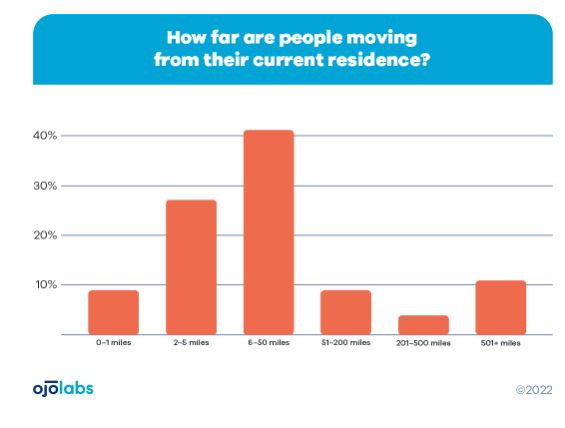
A new study conducted by OJO Labs, an online real estate site and personal finance tool, found that the vast majority of recent home seekers are unwilling to relocate extreme distances, and are instead looking to buy much closer to their current homes.
It suggests that while buying a home in another state may have become a popular move for some during the pandemic—especially for high earners—most people looking for a new home right now are not venturing too far.
The OJO Labs study, published at the very end of March, surveyed more than 500 prospective homebuyers about their experience over that month. Of these, 41% were limiting their search to within six and 50 miles from their current home, while 36% were interested in buying a new house only if it was fewer than five miles away.
Only 11% of respondents were willing to move more than 500 miles away from their current address.
The findings push back on the pandemic-era narrative of New Yorkers and Californians moving to more livable cities in states like Arizona, Texas, and Florida.
My thoughts: Those who are only searching within a 50-mile radius probably won’t find anything that makes it worth moving – the prices aren’t low enough. There needs to be a bigger windfall to compensate for the capital-gains taxes, and feel like a big win. Nobody is going to move just for the heck of it. Thus, our supply is dependent upon those willing to move a long ways.
~~~~~~~~~~~~~~~~~~~~~~~~~~~~~~~~~~~~~~~~~~~~~
View Ford Realty’s Google Reviews

