
Harvard: Housing Market Study: Working from Home
Boston Condos for sale Sale and Rent
Harvard: Housing Market Study: Working from Home
Harvard: Housing Market Study: Working from Home
A lot has changed over the past year. For many people, the rise in remote work influenced what they’re looking for in a home and created a greater appetite for a dedicated home office. Some professionals took advantage of the situation and purchased a bigger home. Other people thought working from home would be temporary, so they chose to get creative and make the space they already had work for them. But recent headlines indicate working from home isn’t a passing fad.
If you’re still longing for a dedicated home office, now may be the time to find the home that addresses your evolving needs. More and more companies are delaying their plans to return to the office – others are deciding to remain fully remote permanently. According to economists from Goldman Sachs in a recent article from CNN:
“Job ads increasingly offer remote work and surveys indicate that both workers and employers expect work from home to remain much more common than before the pandemic.”
Other experts agree. A survey conducted by Upwork of 1,000 hiring managers found that due to the pandemic, companies were planning more remote work now and in the years to come. Upwork elaborates:
“The number of remote workers in the next five years is expected to be nearly double what it was before COVID-19: By 2025, 36.2 million Americans will be remote, an increase of 16.8 million people from pre-pandemic rates.”

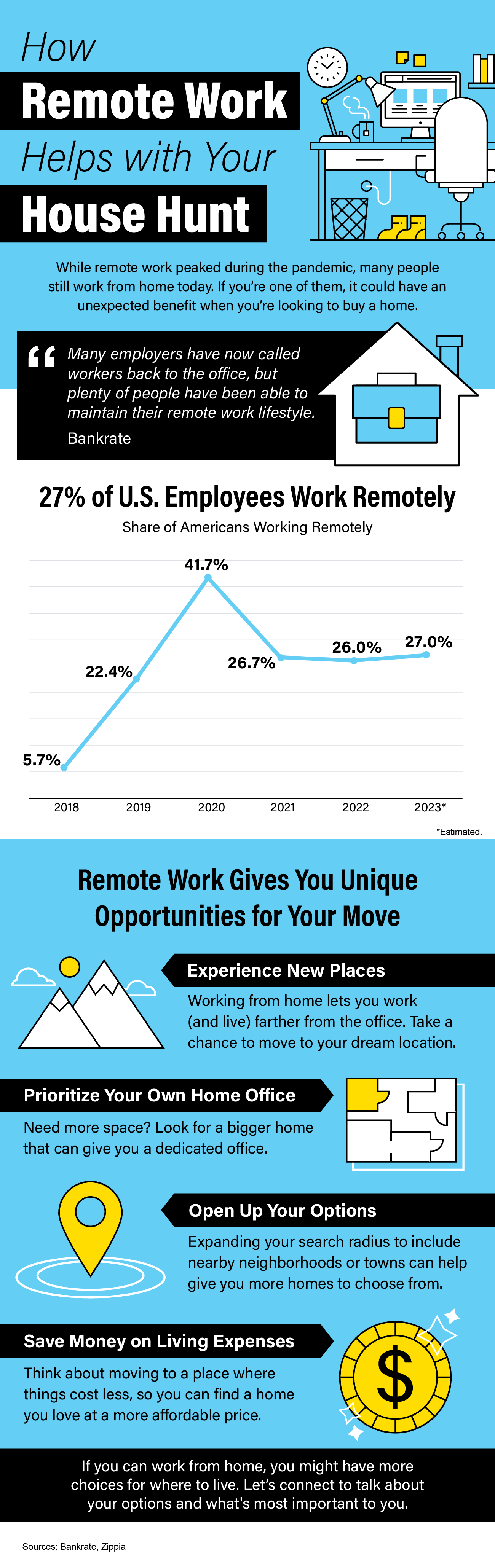
The charts above break down their findings and compare pre-and post-pandemic percentages.
How Does This Impact Homeowners?
If you own your home, it’s important to realize that continued remote work may give you opportunities you didn’t realize you had. Since you don’t need to be tied to a specific area for your job, you have more flexibility when it comes to where you can live.
If you’re one of the nearly 23% of workers who will remain 100% remote:
You have the option to move to a lower cost-of-living area or to the location of your dreams. If you search for a home in a more affordable area, you’ll be able to get more condo for your money, freeing up more options for your dedicated office space and additional breathing room.
You could also move to a location where you’ve always wanted to live – somewhere near the beach, the mountains, or simply a market that features the kind of weather and community amenities you’re looking for. Without your job tying you to a specific location, you’re bound to find your ideal spot.
If you’re one of the almost 15% of individuals who will have a partially remote or hybrid schedule:
Relocating within your local area to a home that’s further away from your office could be a great choice. Since you won’t be going in to work every day, a slightly longer commute from a more suburban or rural neighborhood may be a worthy trade-off for a home with more features, space, or comforts.
Boston Condos for Sale and the Bottom Line
If ongoing remote work is changing what you need in a home, let’s connect to find one that delivers on your new wish list.
Boston Condos for sale Sale and Rent

Click Here to view: Google Ford Realty Inc Reviews
Click to View Google Reviews
Updated: Boston Real Estate 202
_____________________________________________________________________________________________________________________________
Boston Condo for Sale Search
We are now deep enough into the work-from-home experiment that, beyond speculation, we have data about what happens when we work remotely en masse — what we gain and what we lose when we are out of the office.
We’re working more from home
Quite a lot more. The average workday is 49 minutes longer, a study led by Harvard’s Evan DeFilippis showed, based around aggregating when people sent their first and last email of the day. The more qualitative survey, led by Harvard’s Ethan Bernstein, found that in the weeks immediately after lockdown, about half of those surveyed were working more than 10 hours a day, compared to just 20% before lockdown. That figure has dropped, but those surveyed still reported a workday 10% to 20% longer
Who is best suited to work from home
There was a surprising finding when it came to what type of person was best suited to working from home. The expectation of the survey authors was that introverts would find it easiest. But actually, it turned the best indicator was empathy and agreeableness — thinking about the feelings of others was the best predictor of who would fare best working from home. Even when not in physical contact with other people, thinking about them is a key skill. On the flip side, those with a tendency to be neurotic found working from home most difficult, without the regular reassurance that comes from being around colleagues.
Boston Real Estate and the Bottom Line
Boston Companies are currently weighing up whether to bring everyone back to the office, keep everyone at home, or, more likely, create a hybrid of the two. The latter option needs to be handled with care, however, particularly with regards to avoiding the creation of a system where those who work from home are out of sight so out of mind, reducing them to second-class status. Given the needs of social distancing — masks, people needing to spread out reduced common areas — there is a chance company could lose some of the benefits when bringing people back to the office anyway, at least in the near term.
Source: Harvard Business School

