
Has homeownership become a luxury good?
Boston Condos for Sale and Apartments for Rent
It takes 13.9 years to break even on homeownership in Boston
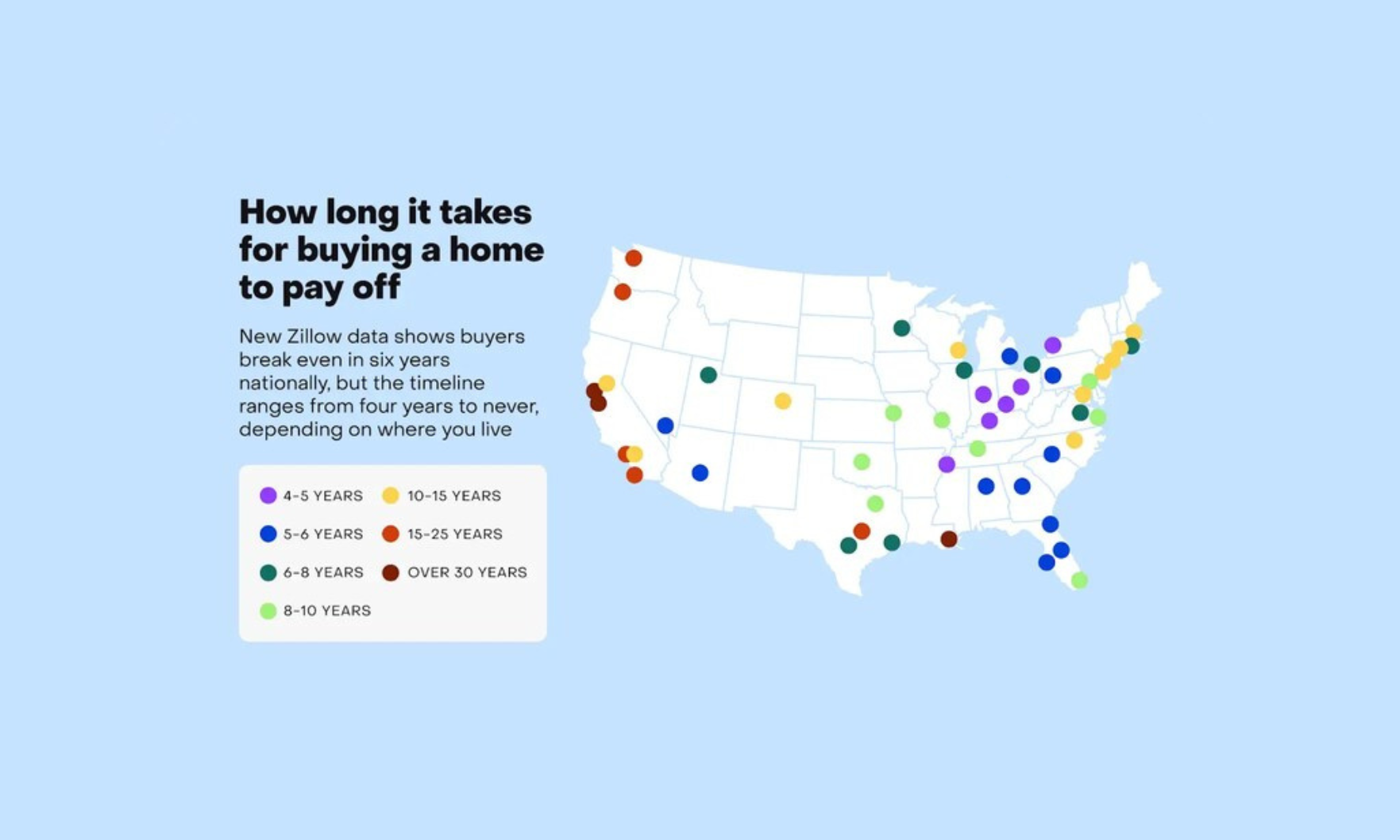
Nationwide, it takes six years to break even on homeownership. That timeline varies widely from city to city. (Credit: Zillow)
Nationwide, it takes six years to break even on homeownership, down from an all-time high of 8.4 years in 2023. However, that timeline is considerably longer in Boston at 13.9 years, according to new data from Zillow.
In its new Rent vs. Buy analysis, the group compared mortgage payments, property taxes, insurance rates and maintenance and closing costs for homebuyers with monthly rent and renters insurance costs to determine how long it takes for buying a home to be a smarter financial decision than renting.
Assuming a 20% down payment, U.S. homeowners stand to gain about $732,000 in housing wealth over the course of a 30-year mortgage, recouping the upfront costs of homeownership and reaping the benefits of improved housing affordability after just 6 years. During the same time frame, renters will have paid $1.44 million in rent and renters’ insurance. Even when accounting for the extra cash renters have at their disposal, that puts them about $1.14 million behind homeowners after 30 years.
The timeline is similar with a 5% down payment: the typical renter is about $1.3 million behind homeowners, who end a 30-year mortgage with about $555,000 in housing wealth, but break even after 5.75 years.
Buyers can break even faster than the national average in just 15 major U.S. metros. In the most optimal market — Columbus, Ohio — buyers are better off than if they’d rented in just 4.1 years.
Conversely, in several cities, buyers never break even: in New Orleans, San Francisco and San Jose, California, buying a home isn’t a smarter financial decision than renting, at least not over a 30-year period.
“For generations, Americans have been told that buying a home is the smartest financial move they’ll ever make. This analysis finds the truth is more complicated,” said Senior Economist Orphe Divounguy. “This research shows that both renting and buying can be smart decisions, just in different cities. The good news is that for buyers who are ready, conditions today are the most favorable they’ve been in years.”
Divounguy added that ZIP code selection could be the most important financial decision in a person’s life.
Overall, the data suggests that households should buy if they plan to stay more than six years, if their city has a quick break-even timeline or if stability and equity are a priority — but they should rent if they plan on moving in less than 6 years, if they life in an expensive coastal city or if they value flexibility and liquid cash.
“The rent-versus-buy decision in 2026 is as much of a lifestyle decision as a financial one,” said Zillow home trends expert Amanda Pendleton. “Do you want a backyard garden and a menagerie of pets? Or do you want to skip yard work entirely and have the flexibility to move on a whim? These types of lifestyle questions are as important as whether or not the math works in your favor.”
Has homeownership become a luxury good?
- Income needed to qualify: The percentage of median household income needed to qualify for a home purchase has nearly doubled from 87% in 2005 to 152% in 2023, making it unattainable for many.
- Price and interest rate hikes: The median home price increased by 35.2% from 2019 to the fourth quarter of 2023. Additionally, mortgage rates in early 2024 were roughly double what they were in early 2022.
- Burden of ownership costs: An analysis by the U.S. Census Bureau revealed that median monthly ownership costs for mortgaged homeowners increased 26% between 2019 and 2024, to $2,035. The average annual cost of owning and maintaining a single-family home exceeded $21,000 in 2025, with maintenance costs alone averaging over $8,800 a year.
- Renters are also cost-burdened: The percentage of median household income needed to rent the average apartment also climbed substantially, rising from 37% in 2004 to 71% in 2023.
- Low supply of affordable housing: A chronic housing shortage, partly caused by more cautious homebuilding after the 2008 financial crisis, has pushed prices up. Low inventory is further reduced by homeowners who refuse to sell, as many are locked into mortgages with low interest rates. Institutional investors also buy up properties, removing them from the market for individual buyers.
- Restrictive zoning policies: Local zoning laws, such as minimum lot sizes and parking requirements, drive up costs and restrict the construction of new, affordable homes.
- Stagnant wages and increasing debt: While housing costs have soared, wage growth has not kept pace. Many younger adults also face significant student loan and other debt, making it harder to save for a down payment.
- A tale of “haves and have-nots”: Rising housing costs and limited supply have created a wider gap between those who can afford homes and those who cannot.
- Generational divide: Millennials and Gen Z are finding it much more difficult to attain homeownership compared to previous generations at the same age. Data shows that the median age of first-time homebuyers has significantly increased.
- Impact on wealth accumulation: For those who are unable to purchase a home, it means missing out on building significant housing wealth over a lifetime
Ford Realty Beacon Hill – Condo for Sale Office

Boston condos for sale – Ford Realty Inc
Updated: Boston Condos for Sale Blog 2025
Byline – John Ford Boston Beacon Hill Condo Broker 137 Charles St. Boston, MA 02114

