
More Borrowers Are Opting for Adjustable-Rate Mortgages
Boston Condos for Sale and Apartments for Rent
More Borrowers Are Opting for Adjustable-Rate Mortgages
If you’ve been house hunting lately, you’ve probably felt the sting of today’s mortgage rates. And it’s because of those rates and rising home prices that many homebuyers are starting to explore other types of loans to make the numbers work. And one option that’s gaining popularity? Adjustable-rate mortgages (ARMs).
If you remember the crash in 2008, this may bring up some concerns. But don’t worry. Today’s ARMs aren’t the same. Here’s why.
Back then, some buyers were given loans they couldn’t afford after the rates adjusted. But now, lenders are more cautious, and they evaluate whether you could still afford the loan if your rate increases. So, don’t assume the return of ARMs means another crash. Right now, it just shows some buyers are looking for creative solutions when affordability is tough.
You can see the recent trend in this data from the Mortgage Bankers Association (MBA). More people are opting for ARMs right now (see graph below):
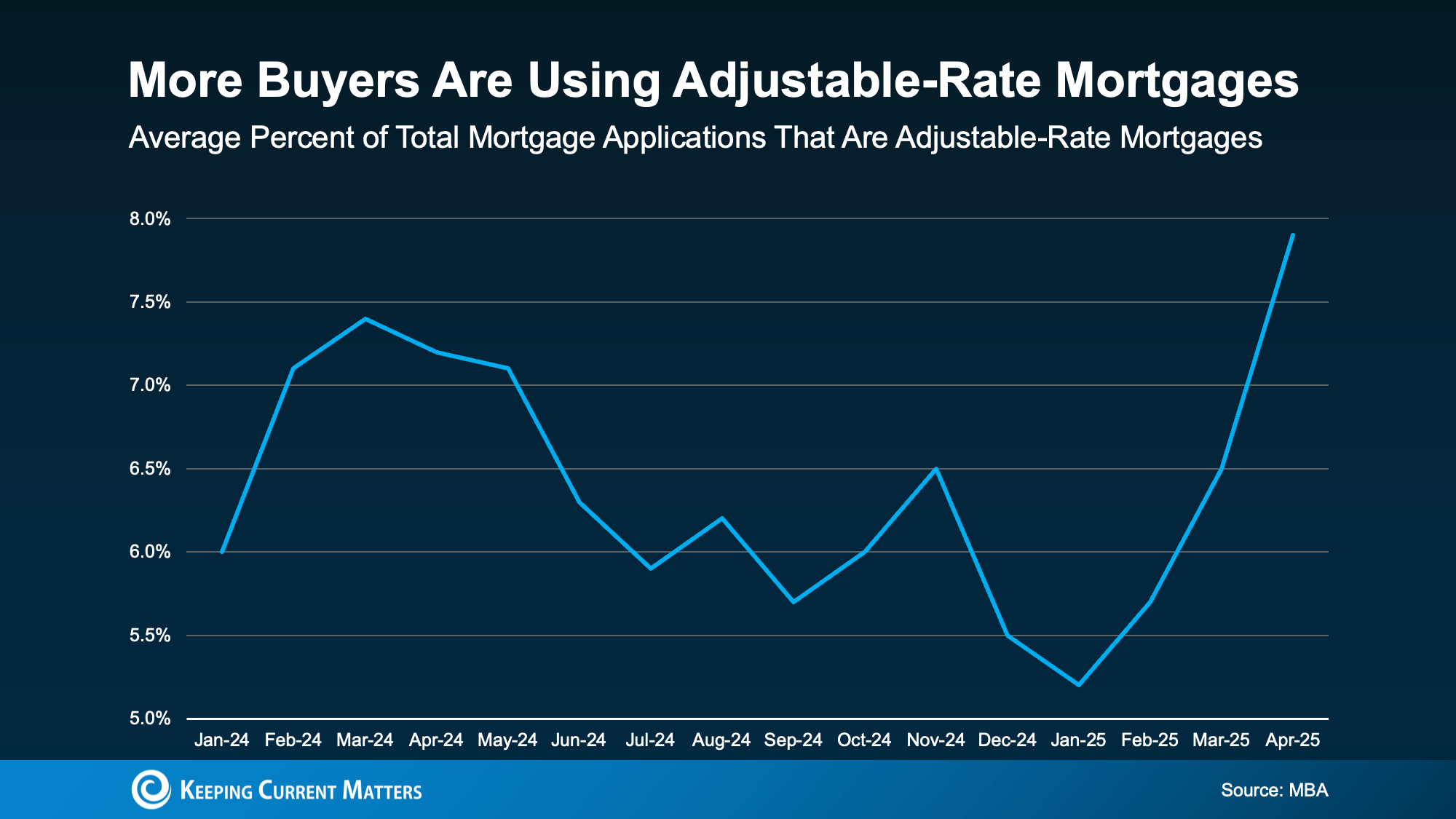 And while ARMs aren’t right for everyone, in certain situations they do have their benefits.
How an Adjustable-Rate Mortgage Works
Here’s how Business Insider explains the main difference between a fixed-rate mortgage and an adjustable-rate mortgage:
“With a fixed-rate mortgage, your interest rate remains the same for the entire time you have the loan. This keeps your monthly payment the same for years . . . adjustable-rate mortgages work differently. You’ll start off with the same rate for a few years, but after that, your rate can change periodically. This means that if average rates have gone up, your mortgage payment will increase. If they’ve gone down, your payment will decrease.”
Of course, things like taxes or homeowner’s insurance can still have an impact on a fixed-rate loan, but the baseline of your mortgage payment doesn’t change much. Adjustable-rate mortgages don’t work the same way.
Pros and Cons of an ARM
Here’s a little more information on why some buyers are giving ARMs another look. They offer some pretty appealing upsides, like a lower initial rate. As Business Insider explains:
“Because ARM rates are typically lower than fixed mortgage rates, they can help buyers find affordability when rates are high. With a lower ARM rate, you can get a smaller monthly payment or afford more house than you could with a fixed-rate loan.”
On the flip side, just remember, if you have an ARM, your rate will change over time. As Barron’s explains there’s the potential for higher costs later:
“Adjustable-rate loans offer a lower initial rate, but recalculate after a period. That is a plus for borrowers if rates come down in the future, or if a borrower sells before the fixed period ends, but can lead to higher costs if they hold on to their home and rates go up.”
So, while the upfront savings can be helpful now, you’ll want to think through what could happen if you’re still in that home when your initial rate ends. Because while projections show rates are expected to ease a bit over the next year or two, no forecast is guaranteed.
That’s why it’s essential to talk with your lender and financial advisor about all your options and whether an ARM aligns with your financial goals and your comfort with risk.
Boston Condos for Sae Bottom Line
For the right buyer, ARMs can offer some big advantages. But they’re not one-size-fits-all. The key is understanding how they work, weighing the pros and cons, and thinking through if they’d be something that would work for you financially. And that’s why you need to talk to a trusted lender and financial advisor before you make any decisions.
More Borrowers Are Opting for Adjustable-Rate Mortgages
As interest rates rise, adjustable-rate mortgages may appeal to more Boston condo buyers in 2022
Although adjustable-rate mortgages are known to be riskier than their fixed-rate counterparts, some home buyers may want to consider them as interest rates keep on rising.
ARMs typically come with a lower initial interest rate than a 30-year fixed
So-called ARMs typically come with a lower initial interest rate than a 30-year fixed-rate mortgage will start with, with the rate subject to change after a defined period of time. Boston condo borrowers must then pay the rate set after the lock period expires, which can mean paying more if interest rates have moved upwards during that time.
Even though interest rates currently remain at historical lows, recent increases have been a shock to some home buyers’ budgets. Rates have jumped by more than 90 basis points in just one month. Higher borrowing costs have coincided with higher home prices, too.
The 30-year fixed-rate mortgage, the most common loan option, averaged 4.67% last week, according to Freddie Mac. That is the highest average since late 2018.
On the other hand, the five-year ARM averaged 3.5% last week.
Boston condo borrowers considering an ARM need to weigh how they’d be able to handle mortgage rate increases after their fixed-rate term expires, typically after three, five, or seven years. An ARM typically comes with caps on the annual adjustment, but these can vary among lenders.
For example, lenders may cap the increase for the first adjustment at 2 percentage points. That would mean the new rate can’t be more than 2 percentage points higher than the initial rate, CNBC explained. A subsequent adjustment cap clause would tell the borrower how much the interest rate could increase in following adjustment periods. Borrowers should review all potential caps and risks fully with a lender before deciding which loan product to choose.
“I’d also be concerned if you do an ARM with a low down payment,” Stephen Rinaldi, president and founder of the mortgage broker firm Rinaldi Group, told CNBC. “If the market corrects for whatever reason and home values drop, you could be underwater on the house and unable to get out of the ARM.”
Rinaldi told CNBC that ARMs often are chosen for purchasers of high-priced homes because the amount saved with the initial rate could be thousands of dollars per year. But for mortgages under $200,000, the savings could be less, he said.
Source: CNBC

View Ford Realty Google Reviews 2021 and 2022
_____________________________________________________________________________________________________________________________________

