
What you need to know about the economy
Boston Condos for Sale and Apartments for Rent
What you need to know about the economy
Top occupations driving US homeownership
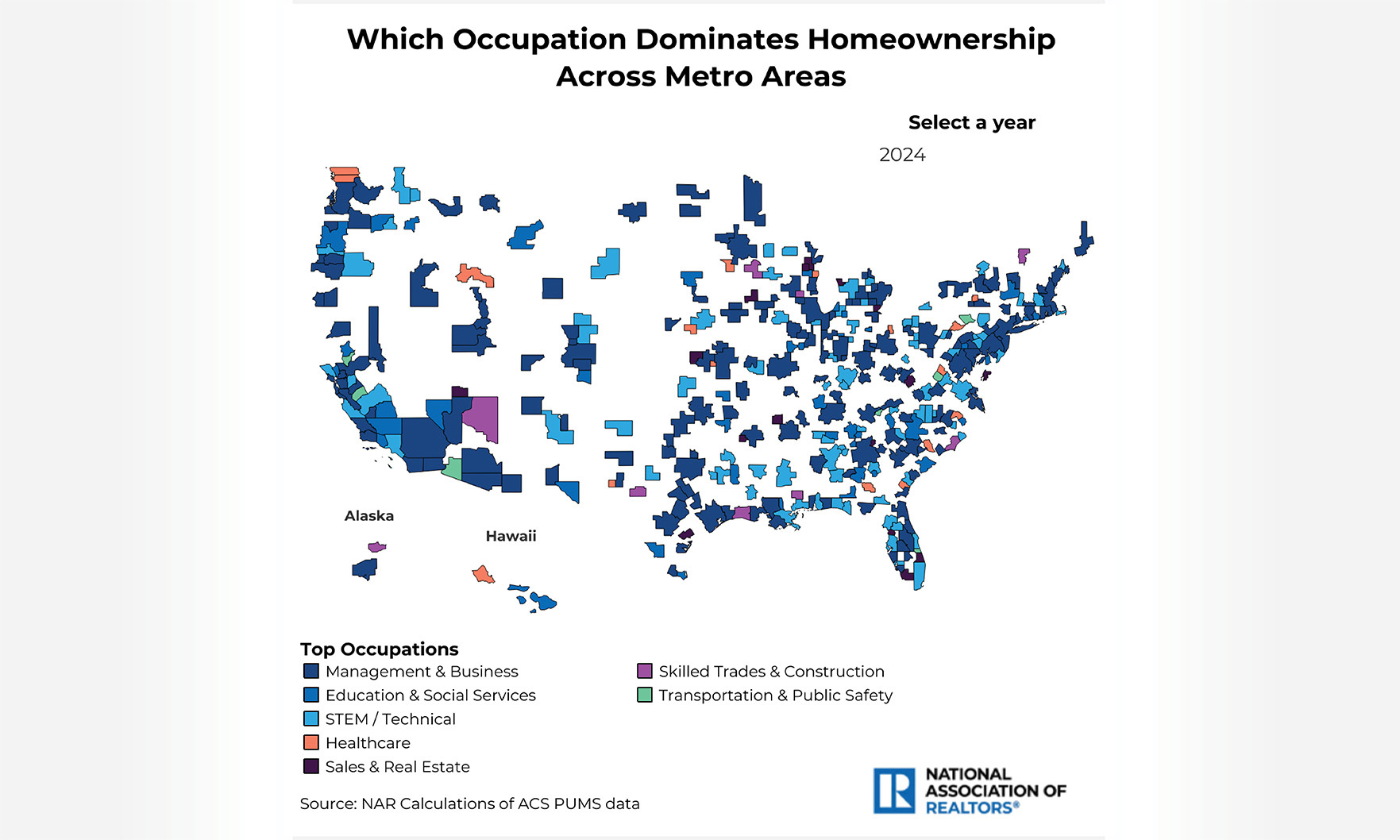
Who is buying homes in America? According to a new report from the National Association of REALTORS® on homeownership trends from 2014 to 2024, the answer often comes down to your job.
Management and business professionals top the list, with about 72.2% of executives, managers and financial workers owning their homes in 2024. Education and social service workers remain close behind at 67.3%, slightly lower than a decade ago.
Workers in engineering and technical professions, including engineers, computer scientists and technical specialists, are also near the top with a 67.2% homeownership rate. Sales and real estate occupations saw gains over the past decade, rising from 60.8% to 63.3%. Healthcare workers now own homes at a rate of 62.2%, and skilled trades and construction workers are at 62%.
Transportation and public safety occupations, including truck drivers, police officers and firefighters, have a 58.1% homeownership rate. Service workers, such as those in hospitality, food service and personal care, have the lowest rate at 45.5%. Notably, however, service occupations have made the largest improvement since 2014, rising from 42.7%.
Overall, in 61.4% of U.S. metropolitan areas, the occupation with the highest homeownership rate today is different from a decade ago, representing a shift in the profile of a typical homeowner. However, home prices in many of these metros closely align with local incomes, paving the way for people across all occupations to own a home.
Peace be with you
Updated: Boston Real Estate Blog 2000 – 2026
Condo Broker 137 Charles St. Boston, MA 02114
South Boston Condos List prices from $500.00 to 1% and Rentals for 2026
Byline: John Ford Boston condo for sale broker.
South Boston condos for sale List from $500.00 to 1% 2026
View South Boston condos for sale and rent for 2026
ASK ABOUT OUR BUYER REBATES
South Boston condos for sale
This content is currently unavailable. Please check back later or contact the site's support team for more information.
List your South Boston condo for only $500.00
Scroll down to view South Boston condos for sale
This content is currently unavailable. Please check back later or contact the site's support team for more information.
Massachusetts has the strongest job market in the US

Massachusetts may offer ideal conditions for jobseekers, according to a new study from WalletHub.
Using data from the U.S. Census Bureau, Bureau of Labor Statistics and other sources, the finance company ranked states based on criteria like median annual income, commute time and job availability. Strong worker protections and job opportunities rocketed Massachusetts to the top spot.
Not only did the Bay State rank No. 1 in the nation for worker protections like equal pay mandates, pay secrecy, flexible scheduling and protections for pregnant or breastfeeding women or those with no salary history, Massachusetts placed fourth for employment growth and third for job security — meaning job options are growing and residents tend to keep their jobs.
“Massachusetts is the best state for jobs, in part because it has one of the highest worker protection scores,” said WalletHub analyst Chip Lupo. “Also, the number of available jobs in Massachusetts increases by around 2.4% per year, the fourth-highest in the nation, so there will be even more opportunities in the future. Once people get jobs in Massachusetts, they’re also likely to keep them, as the state has the third-best job security. To top things off, Massachusetts has the third-lowest percentage of the workforce living in poverty, which demonstrates that workers are generally receiving reasonable pay.”
Tariffs helped push up the price of goods and services up by 2.92 percent from a year ago in August — the fourth month in a row that inflation has moved away from the Federal Reserve’s 2 percent inflation goal.
Thursday’s Consumer Price Index report from the Bureau of Labor Statistics all but rules out a 1/2 percentage point “jumbo” rate cut at next week’s Fed meeting, but central bank policymakers are still expected to bring rates down gradually this year and next.
Fed Chair Jerome Powell last month acknowledged that policymakers are starting to see unemployment as a bigger risk to the U.S. economy than inflation.
The Department of Labor reported Thursday that initial jobless claims climbed to a seasonally adjusted 263,000 last week, the highest level since Oct. 23, 2021.
Most of the surprise jump in jobless claims was attributed to the impact of flash floods in July that killed more than 100 people in Texas.
But the report comes on the heels of Sept. 5 payrolls data that showed employers added just 22,000 jobs to U.S. payrolls in August and that the unemployment rate ticked up to 4.3 percent, with 7.38 million Americans out of work.
Jobless claims hit new 2025 high
Samuel Tombsto claim, and as a rising number of claimants reach the end of the 26-week entitlement” for benefits, Pantheon Chief U.S. Economist Samuel Tombs said in a note to clients.
Forecasters at Pantheon expect the unemployment rate to peak at 4.75 percent early next year, he said.
Tariffs push inflation away from Fed’s target
Since hitting a post-pandemic low of 2.31 percent in April, annual CPI inflation has been climbing for 4 months in a row. Core CPI, which excludes volatile food and energy prices, bottomed at 2.77 percent in May.
Tombs said tariffs were “chiefly responsible” for the rise in August core CPI, which rose to 3.11 percent. Only about 1/3 of the impact that tariffs are ultimately expected to have on prices has been passed on to consumers, he said.
“The middle-class squeeze from tariffs is here,” Navy Federal Credit Union Chief Economist Heather Long posted on X. “It’s troubling that so many basic necessities are rising in price again: Food, gas, clothing and shelter all had big cost jumps in August. And this is only the beginning.”
Forecasters as Pantheon expect the Fed’s preferred inflation gauge, the core Personal Consumption Expenditures (PCE) price index, to peak at between 3.25 percent and 3.5 percent around the end of the year as retailers pass on more tariff costs to consumers.
“The tariff boost will be fleeting, but weakening services inflation will only be resolved by looser monetary policy,” Tombs said. “We continue to think, therefore, that the [Fed] will reduce rates by [1.5 percentage points] over the next 12 months, with [half] of that easing coming by the end of this year.”
Futures markets tracked by the CME FedWatch tool show that investors were pricing in a 86 percent chance Thursday that the Fed will bring short-term interest rates down by at least 3/4 of a percentage point this year, up from 46 percent on Sept. 4.
But futures market investors think the odds of a 1/2 percentage point Fed rate cut on Sept. 17 are long — about 7 percent on Thursday, down from 9 percent on Wednesday.
Stock market indexes nevertheless hit new all-time highs Thursday on expectations that the Fed will initiate a series of rate cuts next week. Yields on 10-year Treasurys, a barometer for mortgage rates, also came down slightly on investor expectations of a Fed rate-cutting campaign.
Mortgage rates at 2025 low
Rates on 30-year fixed-rate mortgages tracked by Optimal Blue hit a 2025 low of 6.27 percent Monday and Wednesday, and were headed lower Thursday.
Although Optimal Blue data lags by a day, rates tracked by Mortgage News Daily showed rates for 30-year fixed-rate mortgages fell by 2 basis points Thursday, in concert with 10-year Treasury yields. A basis point is one hundredth of a percentage point.

