
What’s next for Zillow? Are they in trouble?
Boston Condos for Sale
What’s next for Zillow? Are they in trouble?
Preliminary injunction hearing held in Zillow lawsuit against Compass, MRED
A preliminary injunction hearing requested by Zillow in May was held July 1-2 in the U.S. District Court for the Northern District of Illinois. The hearing will determine whether Zillow can continue enforcing its ban on MRED’s listing feed while its lawsuit against Compass and MRED proceeds toward trial.
The lawsuit, which was filed May 12, followed an April agreement in which Compass said it would share its nationwide listings through MRED’s private listing network as part of an expanded MLS partnership. Zillow alleges the agreement was designed to “threaten Zillow’s Chicagoland listing data feed.”
Zillow also alleges that MRED demanded it restore Compass’ private listings from outside of its territory and threatened to terminate Zillow’s access if it did not comply. MRED ultimately cut off Zillow’s access for two days before a judge ordered the feed restored on May 22.
Separately, last week the Consumer Federation of America, along with housing, consumer and civil rights organizations, urged the Department of Justice and the Federal Trade Commission to investigate the Compass-MRED agreement for potential antitrust violations and civil rights harms.
According to Zillow, chief industry development officer Errol Samuelson told the court on the first day of the hearing that the core problem with Compass’ private listing model is that it routes buyers only through Compass agents, therefore “enabling the brokerage to potentially double-end commissions and off-market inventory as a recruiting tool.”
Samuelson said, “Our brand promise is to show everything on the market. We turn on the lights. If we can’t show everything for sale, we lose brand trust.”
Other witnesses who testified in the two-day hearing included:
- Chris Haran, MRED managing director and chief technology officer
- Fran Broude, Compass regional vice president
- Jeremy Hofmann, Zillow chief financial officer
- Ron McColly, McColly real estate broker
- Lawrence Wu, expert witness
- Robert Reffkin, Compass International Holdings CEO
- Rebecca Jensen, MRED CEO
- Debra Aron, expert witness
Devin Daly Huerta, senior corporate communications lead with Compass, told Chicago Agent, “Zillow’s ban hurts consumers and merely serves to entrench Zillow’s dominance and block consumer choice. Buyers on Zillow are not told that listings are being filtered. There is no disclosure that the available inventory has been hidden from them. MRED’s Private Listing Network (PLN) exists to give sellers control, privacy and flexibility. It has existed for over 10 years without complaint. Zillow NOW seeks to eliminate that choice for its selfish business purposes.”
A ruling is expected after July 13.
Ford Realty Menu of Flat Fee Listings for Boston and the North Shore
As a home seller, it sounds like you have a solid grasp of the current 2026 landscape for flat-fee listings in the Boston and North Shore areas. Here is a concise breakdown of how those Ford Realty tiers typically function based on the service levels you’ve identified:

1. Basic “Entry Only” – $500.00
- Visibility: Your home is listed on the local MLS, which syndicates to Zillow, Realtor.com, and local brokerage sites.
- Your Role: You are the primary point of contact. You handle photography, scheduling all showings, vetting buyers, and all contract negotiations.
- Best for: Experienced sellers or those comfortable managing real estate paperwork and logistics independently.
2. Flat Fee (Assisted) – Starting at $1,500.00
- The Upgrade: The broker takes professional photos and handles the listing setup.
- Added Support: You gain professional guidance for the initial setup, ensuring the listing looks polished to attract higher-quality leads.
- Broker Role: 60-day listing, one open house per month, schedule day and evening showings. The negative is that the full fee is due after 60 days even if the house/condo doesn’t sell or go under agreement.
3. Full-Service – 1% Commission
- The Full Package: Professional photography and floor plans are included.
- Active Management: The broker hosts one open house per month and handles day/evening showings.
- Logistics: They are physically present for the BFD smoke detector inspection and the home inspection, taking significant stress off your plate.
Key Financial Reminders
- Buyer’s Side: Regardless of your flat fee, remember to factor in the 2%–3% commission for the buyer’s agent to keep your home competitive.
- Tax/Closing: Budget for the MA transfer tax ($4.56 per $1,000) and ensure all Condo fees are cleared to avoid delays at closing.
BUYERS REBATE
Boston and North Shore Buyers: We provide a 55% rebate of our commission to you, as the buyer, for homes priced over 500,000.
Click to View Ford Realty’s Google Reviews

Ford Realty Beacon Hill – Condo for Sale Office

Boston condos for sale – Ford Realty Inc
Updated: Boston Condos for Sale Blog 2026
Byline – John Ford Boston Beacon Hill Condo Broker 137 Charles St. Boston, MA 02114
What’s next for Zillow? Are they in trouble?
Yesterday, federal Judge Jeannette Vargas of the Southern District of New York ruled on a petition by Zillow regarding the deal for Anywhere, allowing the portal giant to examine documents and communications in an attempt to determine if Compass misrepresented its reliance on private listings.
What’s next for Zillow? Are they in trouble?
Why did Zillow stock drop 11% last month? Shares of Zillow Group dropped 11.5% in March, according to data provided by S&P Global Market Intelligence. News broke that realtor commissions would be fundamentally changed moving forward, sparking fears of lower demand for Zillow’s services.
___________
What’s next for Zillow? Are they in trouble?
For years, tech companies have been trying to replace real estate brokers with algorithms. In the video below outlines a story about OpenDoor a promising real estate tech company that was built to be the next “big thing” as a result, Zillow felt threated and bought the company.
Here’s what happened next:
Zillow Quits Home Flipping

If you can’t make a profit flipping houses in this market, well then yeah, you should probably stop (hat tip G.A.!)
Real-estate firm Zillow Group is exiting the home-flipping business, saying on Tuesday that its algorithmic model to buy and sell homes rapidly doesn’t work as planned.
The firm’s termination of its tech-enabled home-flipping business, known as “iBuying,” follows Zillow’s Oct. 18 announcement that it was halting all new home purchases for the rest of the year. At the time, Zillow pointed to labor and supply shortages for its inability to renovate and flip houses fast enough.
But Chief Executive Rich Barton said Tuesday that Zillow had failed to accurately predict the pace of home-price appreciation, marking an end to a venture the company once said could generate $20 billion a year.
“We’ve determined the unpredictability in forecasting home prices far exceeds what we anticipated and continuing to scale Zillow Offers would result in too much earnings and balance-sheet volatility,” Mr. Barton said in a statement.
Zillow’s share price was down about 12% in late trading on Tuesday, but before it announced the decision to end home flipping.
The move represents a big hit to Zillow’s top line. Home-flipping was the company’s largest source of revenue, but it has never turned a profit.
Zillow, which will release earnings later on Tuesday, said it would report that its home-flipping business, Zillow Offers, lost $381 million last quarter, resulting in a combined loss of $169 million across all of Zillow. The company said it also plans to cut 25% of its workforce.
Zillow has an inventory of more than 9,800 homes across the U.S. that it is currently shopping to investors. There are another 8,200 homes in contract it has agreed to buy. The company expects to lose somewhere between 5% and 7% on these homes, the company said.
Starting in the summer, competitors such as OpenDoor and Offerpad began to pull back from home purchases in one of the biggest home-flipping markets, Phoenix, as the red-hot pandemic market began to cool.
But Zillow accelerated, according to an analysis of sales records by real estate tech researcher Mike DelPrete, scholar-in-residence at the University of Colorado Boulder. Zillow also paid significantly more than those competitors for each home it purchased, buying homes priced $65,000 above the median on average, according to Mr. DelPrete’s analysis.
By October, the company had listed 250 Phoenix homes at an average price discount of 6.2% below what it had paid for them. Mr. DelPrete called Zillow’s price blunder “a catastrophic failure.”
A wider look at Zillow’s national performance by analysts at KeyBanc Capital Markets found it had listed 66% of homes at prices below what it had paid for them, with an average discount of 4.5%.
Zillow said it expects that the wind-down of its home-flipping outfit will take several quarters.
_________________________________________________________________________________________________________________________________________________________________________________________________________________________________________________________
Boston Condos for Sale
What’s next for Zillow? Are they in trouble?
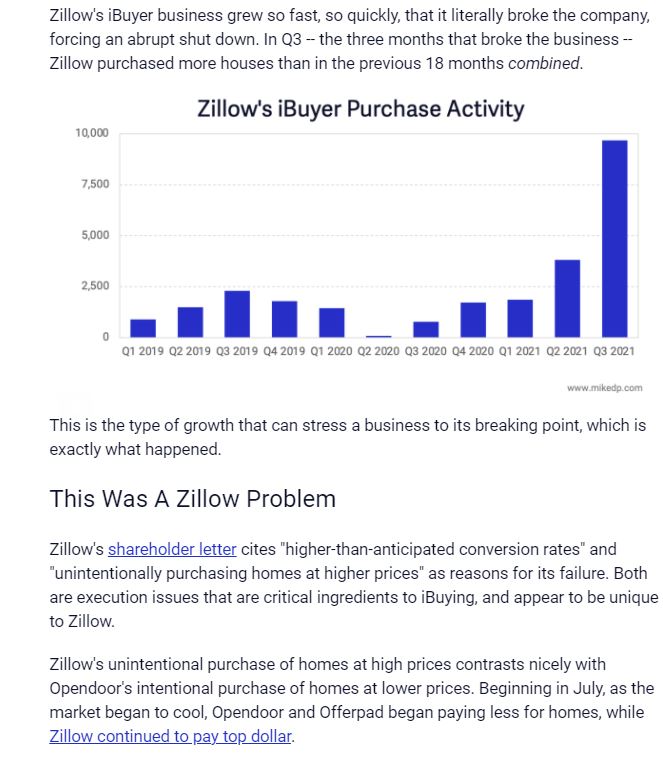
Mike pointed out that Zillow simply kept paying too much for homes, and instead of adjusting on purchase prices being offered, they shut it down yesterday.
But Zillow is too big and too aggressive to rest.
Here’s what Mike thinks could be next:
While Zillow 2.0 may have been a failed experiment in iBuying, what captures the imagination is the next iteration of the business. How will Zillow leverage its massive competitive advantage and its iBuyer learnings for Zillow 3.0?
I wouldn’t be surprised to see Zillow play deeper in the Power Buyer space, a model that is asset-light, easier to scale, less risky with better unit economics, and has a natural overlap with Zillow Home Loans (Opendoor diversified into Power Buying earlier this year).
Zillow as a Power Buyer — either through organic development, partnership, or acquisition — is a natural extension to its existing business of helping home buyers. The world of real estate has evolved significantly since 2018, and Zillow needs to stay relevant to those evolving consumer needs.
It would be a smart move. The buyer side is where the help is needed.
Assisting buyers with making all-cash offers is a very attractive service, with no real downside because all they have to do is funnel the business into their mortgage company to refinance the purchases after the fact. They could flip these buyers to their Premier Agents too – a group who is wondering if it’s worth it to be a Zillow customer today.
The supply and demand will be out of balance for years to come, and buyers are the ones that really need the help. Go Zillow!
Boston Condos for Sale

Click Here to view: Google Ford Realty Inc Reviews
Click to View Google Reviews

